Category : Reverse Engineering
Description :
"this one is easy" find the name when the serial is this : 566C01447A4B47144473486F204E034F70012343754F505C435D
𝐀𝐮𝐭𝐡𝐨𝐫 : 𝐁𝐥𝐚𝐜𝐤𝐤𝐚𝐝𝐞𝐫
Files Given : 'ser.tar'
Solution
Ok we have a .tar file (an archive) , let's extract it using the tar command

Oh the challenge is corrupted , it's not our problem , it's the author's fault
IS ITTTT ???
Didn't i tell you that we have two bestfriends ??? one of them is the key for revealing the secret behind this file and that one bestfriend is file

ohh it's an executable , the author is just playing games with us , lets add the execution permission and try to run it
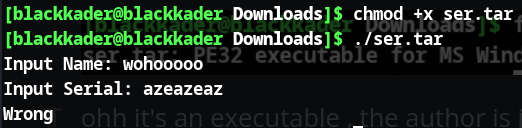
Hmmm , a name and a serial , in the description it is asking us to find the name for this serial 566C01447A4B47144473486F204E034F70012343754F505C435D
Time to decompile our program and see what it does , here comes IDA
int __cdecl main(int argc, const char **argv, const char **envp)
{
  signed int v3; // ebp
  int i; // esi
  char v6; // [esp+Ch] [ebp-130h]
  _BYTE v7[2]; // [esp+Dh] [ebp-12Fh] BYREF
  char v8[100]; // [esp+10h] [ebp-12Ch] BYREF
  char Buffer[197]; // [esp+74h] [ebp-C8h] BYREF
  __int16 v10; // [esp+139h] [ebp-3h]
  char v11; // [esp+13Bh] [ebp-1h]

  memset(v8, 0, sizeof(v8));
  memset(Buffer, 0, sizeof(Buffer));
  v10 = 0;
  v11 = 0;
  v6 = 16;
  qmemcpy(v7, " 0", sizeof(v7));
  sub_4011B9(aInputName);
  scanf("%s", v8);
  v3 = 0;
  for ( i = 0; v3 < (int)strlen(v8); ++i )
  {
    if ( i >= 3 )
      i = 0;
    sprintf(Buffer, "%s%02X", Buffer, v8[v3++] ^ v7[i - 1]);
  }
  memset(v8, 0, sizeof(v8));
  sub_4011B9(aInputSerial);
  scanf("%s", v8);
  if ( !strcmp(v8, Buffer) )
    sub_4011B9(aCorrect);
  else
    sub_4011B9(aWrong);
  return 0;
}
Again , names are confusing , let's rename them to our liking
int __cdecl main(int argc, const char **argv, const char **envp)
{
  signed int j; // ebp
  int i; // esi
  char v6; // [esp+Ch] [ebp-130h]
  _BYTE key[2]; // [esp+Dh] [ebp-12Fh] BYREF
  char input[100]; // [esp+10h] [ebp-12Ch] BYREF
  char Buffer[197]; // [esp+74h] [ebp-C8h] BYREF
  __int16 v10; // [esp+139h] [ebp-3h]
  char v11; // [esp+13Bh] [ebp-1h]

  memset(input, 0, sizeof(input));
  memset(Buffer, 0, sizeof(Buffer));
  v10 = 0;
  v11 = 0;
  v6 = 16;
  qmemcpy(key, " 0", sizeof(key));
  Print(aInputName);
  scanf("%s", input);
  j = 0;
  for ( i = 0; j < (int)strlen(input); ++i )
  {
    if ( i >= 3 )
      i = 0;
    sprintf(Buffer, "%s%02X", Buffer, input[j++] ^ key[i - 1]);
  }
  memset(input, 0, sizeof(input));
  Print(aInputSerial);
  scanf("%s", input);
  if ( !strcmp(input, Buffer) )
    Print(aCorrect);
  else
    Print(aWrong);
  return 0;
}
sooo , the interesting part is the part that generates the serial
for ( i = 0; j < (int)strlen(input); ++i )
  {
    if ( i >= 3 )
      i = 0;
    sprintf(Buffer, "%s%02X", Buffer, input[j++] ^ key[i - 1]);
  }
If we can reverse that we can get the name of the serial
Well , it's xor againn ( enough with the xor already )
Didn't we learn that xor is reversible ???? Time to solve then..
But wait !!!
we have i starting from 0 and in the sprintf line we have key[i-1]
so for the first iteration we will get key[-1] ?????
This is not python , oupsss the author made an error , time to contact him
DId he ??
Time for dynamic analysis :DD , let's put a breakpoint in the xor line
(You can right click in the pseudocode then click Synchronize with Ida view)
And when you get to the ida view , u look for the xor and set a breakpoint there, then you start debugging
Time to run our program and inspect the value of ecx ( which is our key[i-1])
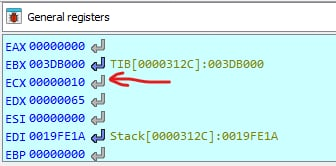
boom ! ecx=0x10=16
Another two iterations will give the expected values of key[0]=" "(0x20=32='ord(" ")') and key[1]="0"(0x30=48='ord("0")')
Time for our solverrrrr :
serial= "566C01447A4B47144473486F204E034F70012343754F505C435D"
key=" 0"+chr(16)
i=0
name=""
for j in range(0,len(serial)-1,2):
    if(i>=3):
        i=0
    name=name+chr(int(serial[j:j+2],16)^ord(key[i-1]))
    i=i+1

print(name)
Running the script will give us this output, which is our flag !
FL1TZ{W4tch_0n3_P13cE_plS}
Is the author suggesting something ?? NO HE IS ORDERING YOU! (politely)